



Belugas and dolphins find a new home at Valencia's Oceanogràfic.
After months of uncertainty and a race against time, two belugas and four dolphins have found a new home at Valencia's Oceanogràfic.
For six marine mammals from Canada, a seven-hour flight across the Atlantic has marked the beginning of a completely new chapter.
Cleopatra and Jelly Bean, two female beluga whales, together with four dolphins — Tsunami, Lida, Echo and Marina — have arrived at the Oceanogràfic in Valencia after being rescued from Marineland in Ontario. Their transfer was part of an international effort to prevent the animals from being euthanised following the closure of the Canadian marine park.
The journey was anything but an ordinary relocation. Months of preparation were required before the animals could leave Canada. Veterinary specialists assessed each cetacean individually, examining their health and determining whether they were fit enough to withstand the long and complex journey.
The teams also had to consider the animals' social relationships. Belugas and dolphins are highly social species, and maintaining familiar companionship while minimising stress were important considerations when deciding how the animals would be transported.
Eventually, the moment arrived. The six animals travelled by road from Marineland to Toronto before boarding a specially chartered aircraft bound for Spain. After around seven hours in the air, they landed in Valencia, where Oceanogràfic specialists were waiting to continue the operation.
Their arrival has been described as a rescue that ultimately saved their lives. The Canadian government had previously faced the difficult challenge of finding suitable homes for the remaining Marineland cetaceans, with official documents stating that, without appropriate relocation options, the alternative could be death.
Valencia was chosen as the destination for the animals because of Oceanogràfic's extensive experience in caring for marine mammals. The centre was also involved in the rescue of two belugas from Ukraine in 2024, animals that had been living close to the conflict zone in Kharkiv.
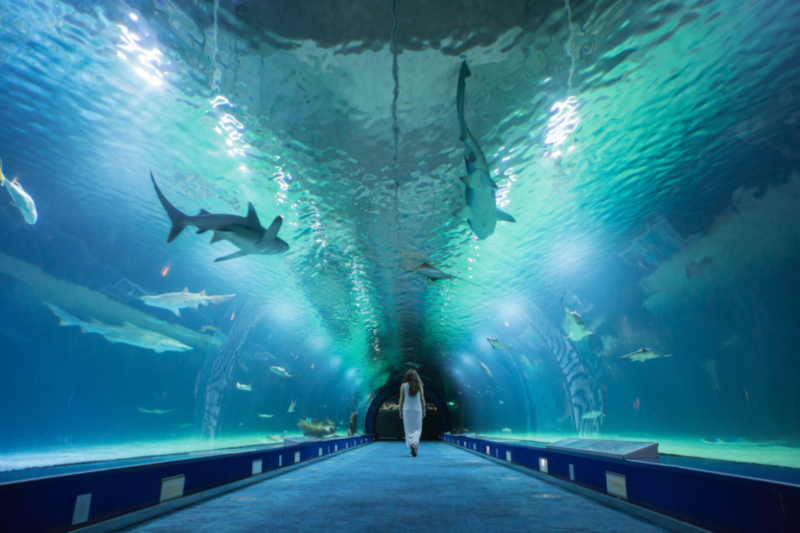
The Oceanogràfic Valencia is the largest aquarium in Europe, home to more than 45,000 animals and renowned for its striking modern architecture.
Its distinctive buildings form part of the spectacular City of Arts and Sciences complex. The wider complex was conceived by architect Santiago Calatrava, while the Oceanogràfic itself features the work of renowned Spanish-Mexican architect Félix Candela. His famous hyperbolic roofs, designed to resemble waves, are among the most recognisable features of the complex and represented his final major project.
The structural design also involved the collaboration of engineers Alberto Domingo and Carlos Lázaro, creating one of Valencia's most distinctive architectural landmarks.
Beyond its impressive architecture, Oceanogràfic is recognised for its commitment to animal welfare and conservation. The aquarium meets international standards for animal safety and welfare and is accredited by major zoological organisations, including the European Association of Zoos and Aquaria (EAZA) and the Association of Zoos and Aquariums (AZA).
The centre also plays an active role in the conservation of marine mammals and participates in rescue, research and preservation programmes.
The latest arrivals will not be placed on display immediately. Instead, they will remain in areas away from visitors while their caregivers monitor their health and behaviour and allow them time to adjust to their new surroundings.
Only when the animals are ready will the next stage begin: gradually introducing them to their new environment and, where appropriate, to other cetaceans.
The rescue has also reignited the debate about what should happen to marine mammals when the facilities housing them close. Animal welfare organisations have argued for the development of marine sanctuaries as an alternative to transferring captive cetaceans between aquariums.
But for Cleopatra, Jelly Bean, Tsunami, Lida, Echo and Marina, the immediate story is one of survival.
After an uncertain future in Canada, they have arrived safely in Valencia — and, for now, they have been given something they desperately needed: time and a place to call home.
The Oceanogràfic in Valencia is much more than an aquarium: it is one of Europe's leading marine centres and an international benchmark for marine research, conservation and education.